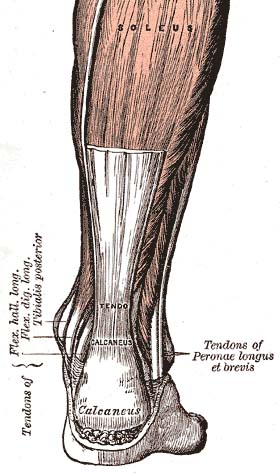
Henry Gray, <a href="https://commons.wikimedia.org/wiki/File:Achilles-tendon.jpg">Wikimedia Commons</a>, public domain. Unmodified.
An Achilles problem does not necessarily mean a footballer has torn the tendon. Tendinopathy is a condition involving pain and reduced tolerance of loading, and its management can be particularly difficult in a sport that asks players to accelerate repeatedly. Some players remain available with carefully managed symptoms, while others require a prolonged period away from competition.
Why the tendon becomes painful
The Achilles connects the calf muscles to the heel bone. Its collagen-rich structure transfers force and stores elastic energy, allowing the ankle to contribute to running, jumping and changes of pace. The tendon adapts to physical loading, but a change in the demands placed on it can exceed its capacity to respond.
Tendinopathy is not simply inflammation, although inflammation-related processes can contribute. Changes in tendon structure, pain sensitivity and muscle function may all play a role. A scan showing tendon abnormalities does not automatically establish how much pain an athlete will experience or whether the athlete is fit to play.
There are two broad locations: midportion tendinopathy affects the tendon above the heel, while insertional tendinopathy occurs near its attachment to the heel bone. Compression against the bone can be particularly relevant to insertional symptoms, so rehabilitation exercises suitable for one presentation may require modification for the other.
How it affects a footballer
Morning stiffness, local tenderness and discomfort during running or heel raises are common features. Symptoms may initially improve during a warm-up, only to become more noticeable after training or the following morning. That delayed response can complicate decisions about participation during a congested fixture schedule.
A clinician will assess the pattern of pain, local tenderness and the ability to load the calf and ankle. Imaging may be useful if the presentation is atypical or if another condition is suspected. Sudden severe pain, a popping sensation or a marked loss of push-off strength needs prompt assessment for a possible rupture rather than being assumed to be an ordinary flare-up.
A five-season UEFA Elite Club Injury Study examined 88 Achilles pain injuries and identified tendinopathy as the leading diagnosis in both anatomical locations. It provides a useful reminder that tendon pain in football is a clinical category in its own right, rather than a synonym for rupture.
Recovery is not a fixed number of matches
Some relatively mild episodes can be managed through adjustments to training, while persistent cases may need months of rehabilitation. A player may miss matches because the tendon cannot tolerate the intensity required, even if everyday activity remains comfortable. The duration of the symptoms and the response to loading are important considerations.
The 2024 midportion Achilles tendinopathy clinical practice guideline supports progressive tendon-loading exercise as a central treatment. Its recommendations relate specifically to midportion disease and should not be applied without modification to every painful Achilles presentation.
Supporters should distinguish a reduction in pain from a restoration of sporting capacity. A footballer who can complete an individual session may still lack the ability to reproduce high-speed actions throughout a match. Progress is also unlikely to follow an entirely smooth trajectory.
Filip Kostić and Jaap Stam
In March 2023, Filip Kostić left the Serbia squad and returned to Juventus for treatment. His national team coach identified Achilles tendinitis as the reason for his withdrawal, in comments reported by beIN Sports. The episode illustrates how an international break can be interrupted by a tendon problem without a reported complete tear.
Former Manchester United defender Jaap Stam also disclosed Achilles tendinitis during his playing career, with Sky Sports reporting his planned operation. That historical case represents a different treatment approach from the exercise-led management commonly recommended today. Neither public report establishes a detailed rehabilitation protocol or an expected recovery time for another player.
Building the tendon back up
Management begins with identifying the activities that aggravate symptoms and finding a tolerable training load. The medical team may temporarily reduce sprinting or jumping and use alternative conditioning to preserve general fitness. Complete inactivity is not usually the goal when the tendon can safely tolerate some exercise.
Strengthening is progressed according to the individual’s symptoms and functional capacity. Both calf muscles matter, and later work must prepare the tendon for faster loading and repeated energy storage. The amount of compression at the heel attachment may influence exercise selection in insertional cases.
The Royal National Orthopaedic Hospital guidance provides further information on exercise-based management. Surgery may be considered in selected persistent cases after appropriate non-operative treatment, but it is not a routine first response to tendon pain.
Football-specific rehabilitation progresses towards running, acceleration, jumping and repeated directional changes. Medical teams consider symptoms during and after activity, calf performance and the response to successive sessions. Returning to a match does not mean the conditioning programme should stop.
Questions about Achilles tendon pain
Is tendinopathy the same as tendinitis? Tendinopathy is the broader clinical term for persistent load-related tendon pain and impaired function. Tendinitis implies inflammation, which does not fully explain every presentation.
Can a player train with tendinopathy? Sometimes, under an individualised plan. Continuing unrestricted training despite worsening symptoms is not equivalent to appropriate load management.
Will it inevitably become a rupture? No. Tendinopathy and rupture are different diagnoses, although tendon disease may be relevant to injury risk. Sudden new symptoms require reassessment.
Image: Henry Gray, Wikimedia Commons, public domain. Unmodified.
Educational information only. This AI-assisted guide has not been independently medically reviewed and does not replace individual medical assessment or clinician-led treatment. References checked November 2026.