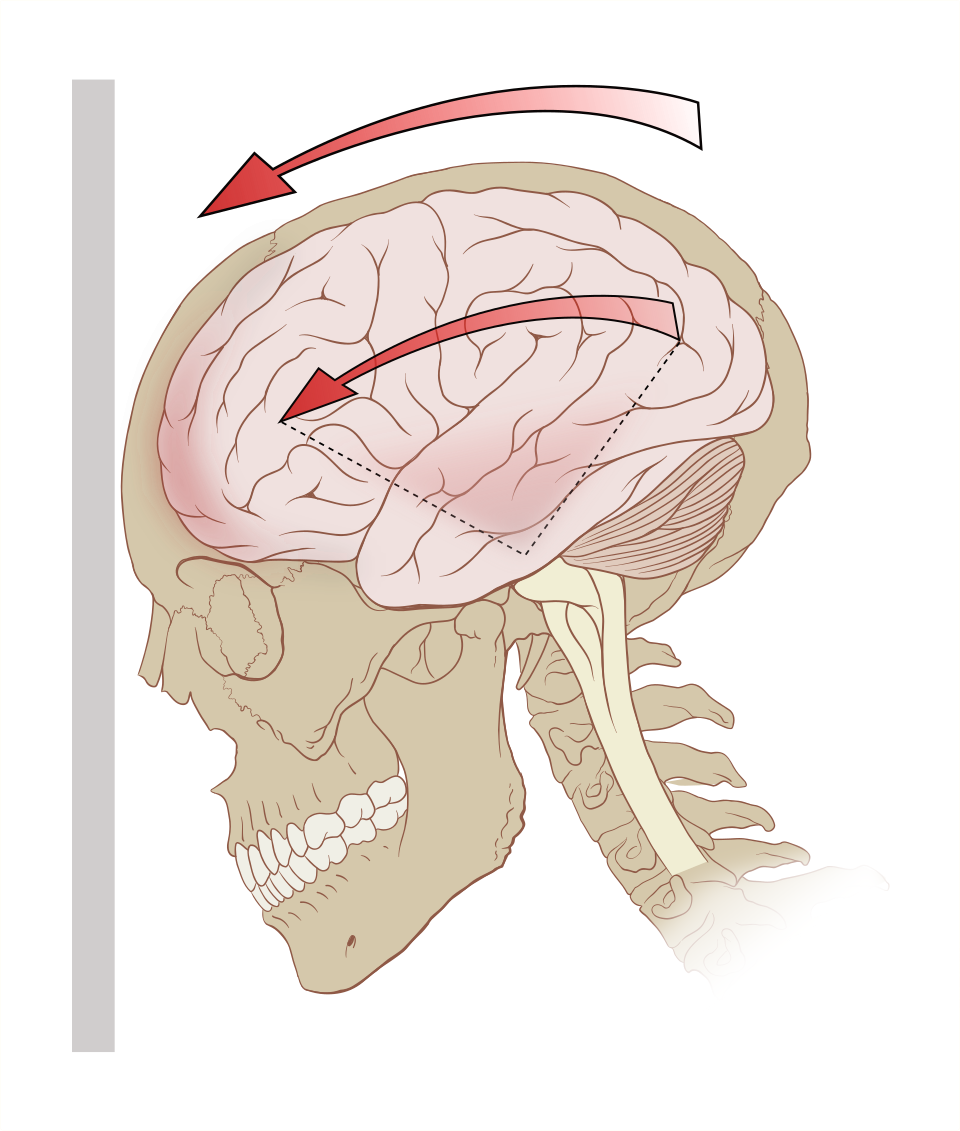
Patrick J. Lynch, medical illustrator; C. Carl Jaffe, MD; modified by Delldot, <a href="https://commons.wikimedia.org/wiki/File:Concussion_mechanics.svg">Wikimedia Commons</a>, <a href="https://creativecommons.org/licenses/by/2.5/">CC BY/2.5</a>. PNG rendering of original diagram.
Unlike a strained muscle or a fractured bone, concussion can affect thinking, balance, vision and behaviour without producing an obvious external injury. In football, a collision during an aerial challenge or a fall can cause concussion even when a player remains conscious. The priority is immediate recognition and safety, not establishing how quickly the player can return.
What happens to the brain?
Sport-related concussion is a traumatic brain injury resulting from a force transmitted to the brain. The impact can be directly to the head or indirectly through another part of the body. Rapid acceleration and rotation can disrupt normal brain function, producing a complex pattern of symptoms.
Concussion is primarily a clinical diagnosis. Ordinary structural imaging may be normal, even when symptoms are significant. CT may be needed to investigate suspected bleeding or other serious injuries, but a normal scan does not by itself exclude concussion.
Headache, dizziness, nausea, blurred vision, confusion, memory difficulties and sensitivity to light or noise are possible symptoms. Some develop immediately and others emerge later. Loss of consciousness is not necessary for a concussion diagnosis.
The immediate decision on the pitch
The Football Association’s concussion guidance requires immediate removal when concussion is suspected. A player should not return to play that day and requires assessment by an appropriate healthcare professional. The athlete’s own desire to continue is not a reliable basis for clearance.
A potentially serious head or neck injury requires emergency management. In the UK, call 999 for a player who remains unconscious, has a seizure, cannot stay awake, or develops new weakness or problems speaking after a head injury. Repeated vomiting or worsening severe headache requires urgent emergency assessment. Follow the NHS head injury guidance for further warning signs and appropriate care.
A responsible adult should monitor the injured person as advised by healthcare staff. Symptoms can evolve after the match, and a player who initially feels well may still need further assessment. Do not move someone with a suspected serious spinal injury unnecessarily.
Two examples from club football
Club Brugge published a medical update on Simon Mignolet following a collision during a match against Charleroi. The goalkeeper spent a night under observation in hospital and was subsequently discharged with a concussion but no fractures. The report demonstrates that absence of a fracture does not exclude a brain injury.
Darlington also reported that goalkeeper Rory Watson was taken to hospital after a concussion during a match. These incidents illustrate the importance of taking symptoms seriously across all levels of football, rather than treating concussion as a concern only for elite players.
Why there is no single return date
The Amsterdam international consensus statement reported a pooled average return to unrestricted sport of around 20 days across a range of studies. Individual recovery varies considerably, however, and some athletes experience symptoms for much longer.
In UK grassroots sport, the national concussion guidelines specify no competitive return before 21 days following injury, alongside successful completion of a graduated programme and the required symptom recovery. That minimum is not permission to return automatically on day 21.
Professional football may have different competition-specific protocols where advanced medical care is available. A professional player’s clearance should not be used as a template for a grassroots player. The relevant governing body’s current rules and the treating clinician’s assessment must guide the decision.
Recovery involves more than resting
Current consensus favours relative rest during the first 24 to 48 hours rather than prolonged isolation in a dark room. Appropriate daily activities and gentle physical activity can be introduced according to symptoms and clinical advice, while avoiding any risk of another head impact.
The progression then incorporates increasing cognitive and physical activity. A clinician may prescribe supervised aerobic exercise and address particular difficulties such as dizziness, visual symptoms, headache or sleep disturbance. Persistent symptoms may need a multidisciplinary assessment.
Return to work or education and return to sport are related but distinct considerations. For younger players, school participation and age-appropriate safeguarding are particularly important. The recovery programme must be tailored rather than copied from an adult professional’s experience.
Sport-specific exercise is introduced without exposure to head impact before later stages involving contact or collision risk. Medical authorisation and satisfactory recovery are necessary before those later stages. If symptoms recur during progression, the athlete should stop and seek guidance rather than attempting to push through.
Repeat injuries and long-term concerns
Another head injury before recovery is complete is a serious concern. Repeated concussions, persistent symptoms and a history of prolonged recovery can influence future medical decisions about participation. These are individual clinical matters and cannot be resolved by counting the number of previous injuries alone.
Research into long-term neurological health in football continues. It is important to distinguish population-level findings about repeated head impacts from predictions about any individual footballer. Decisions about continued participation or retirement may require specialist assessment and discussion of the player’s circumstances.
Frequently asked questions
Can a player have concussion without being knocked out? Yes. Many concussions occur without loss of consciousness.
Does a normal CT scan mean the player is safe to play? No. A normal scan does not exclude concussion or establish recovery.
Can a player return as soon as the headache disappears? No. Symptoms are only part of the assessment, and the appropriate graduated return programme and governing-body requirements must be completed.
What if symptoms last more than four weeks? Persistent symptoms warrant further clinical assessment and may require targeted rehabilitation.
Image: Patrick J. Lynch, medical illustrator; C. Carl Jaffe, MD; modified by Delldot, Wikimedia Commons, CC BY 2.5. PNG rendering of the existing diagram.
Educational information only. This AI-assisted guide has not been independently medically reviewed and does not replace individual medical assessment or clinician-led treatment. References checked November 2026.