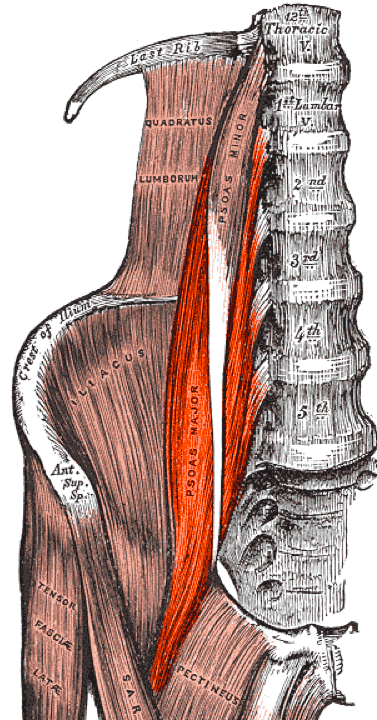
Gray's Anatomy; colourised by Michael Gasperl, public domain, <a href="https://commons.wikimedia.org/wiki/File:Psoas-major.png">Wikimedia Commons</a>. Unmodified.
A player can appear comfortable walking around the pitch and still find it difficult to accelerate or lift a leg high enough to control the ball. Hip flexor injuries are particularly relevant to football because these muscles are involved in repeatedly bringing the thigh forward, whether during sprinting, kicking or changing direction.
A group of muscles, not a single structure
Hip flexion is the movement that brings the thigh towards the trunk. The iliopsoas, formed principally by psoas major and iliacus, is a major contributor. The rectus femoris, sartorius and other muscles also assist with hip flexion.
The psoas major originates in the lumbar region, while iliacus lies within the pelvis. Their tendons converge towards an attachment on the upper femur. This anatomy explains why symptoms may be felt deep at the front of the hip or in the groin rather than at an easily identifiable surface location.
A hip flexor injury can involve muscular or tendon tissue. Acute strains may occur during forceful kicking, sprinting or reaching, while repetitive loading may contribute to more gradual symptoms. The generic label does not establish exactly which structure has been affected.
Why assessment matters
Pain when lifting the thigh, accelerating or extending the hip can be associated with a hip flexor problem. Weakness or discomfort during resisted hip flexion may be relevant during examination. However, pain in this area can also arise from the hip joint, adductors, abdominal structures or bone.
The American Academy of Orthopaedic Surgeons guide to hip strains describes the variety of muscles that can be involved. Clinical assessment helps establish whether a strain is the likely explanation and whether imaging is necessary.
In younger players, sudden pain during an explosive movement can sometimes reflect an avulsion fracture at a developing bone attachment. Severe pain, inability to bear weight or persistent unexplained symptoms should prompt medical evaluation. Simply attempting to stretch away the discomfort can delay appropriate assessment.
How long before a footballer returns?
A minor muscular problem may settle within days or a couple of weeks, while more substantial strains can require several weeks or longer. Significant tendon injury, a fracture or a different underlying diagnosis may extend recovery considerably.
A 16-year UEFA Elite Club Injury Study reported a median absence of 13 days for the category of hip flexor pain. The category included only 35 recorded cases in the relevant dataset. It should not be interpreted as a standard return date for a confirmed severe iliopsoas tear.
A club reporting tightness or soreness has not necessarily confirmed a structural muscle injury. Where the exact pathology is undisclosed, the safest interpretation is that the medical staff are managing symptoms and assessing function.
Matheus Cunha and Pau Cubarsí
Manchester United’s official preview of the Liverpool match in May 2026 identified a hip flexor issue affecting Matheus Cunha following the Chelsea fixture. The head coach described it as relatively minor, although the forward had missed the preceding match against Brentford.
Barcelona also reported iliopsoas tightness in Pau Cubarsí in November 2026. Both examples illustrate the type of public medical information available to supporters, but neither report established a specific grade of muscle tear.
The distinction is useful for injury reporting. A player suffering discomfort and another with a confirmed structural tear may both be described as having a hip flexor problem, even though their management and recovery expectations can differ.
Restoring movement without rushing the muscle
Treatment of uncomplicated strains generally involves modifying provocative activity and progressively restoring movement and strength. Initially, the medical team may limit actions that reproduce substantial symptoms. Complete inactivity is not necessarily required if appropriate conditioning can be maintained without aggravating the injury.
As the player progresses, resistance exercises can restore the ability to lift and control the thigh through different ranges of motion. Rehabilitation also considers the muscles around the pelvis and trunk, since they contribute to the control required during running and kicking. The choice of exercises depends on the precise diagnosis.
Controlled running is followed by increasingly demanding accelerations and football-specific movement when appropriate. Kicking should be progressed according to tolerance, rather than assuming the ability to jog establishes readiness for powerful shooting.
The player must eventually manage repeated efforts and the unpredictable movements of a competitive fixture. The medical team considers strength, symptoms, movement quality and the reaction to training before progressing towards unrestricted participation.
The importance of identifying persistent symptoms
Hip flexor-related pain does not always resolve on the first expected timetable. Persistent symptoms may warrant a reassessment of the original diagnosis, the load imposed during rehabilitation or the presence of another problem. Returning to matches without addressing meaningful limitations may create further difficulties.
Progressive conditioning, suitable warm-ups and careful management of abrupt increases in workload can help support preparation for football. These measures reduce neither every risk nor the need for individual treatment.
Is a hip flexor injury the same as a groin strain? Not necessarily. The groin is a region where symptoms can originate from several structures, including the hip flexors and adductors.
Can an iliopsoas injury require surgery? Most uncomplicated muscular strains are managed conservatively, but selected severe injuries or alternative diagnoses may require specialist intervention.
Why does kicking hurt when walking feels normal? Kicking requires greater speed, range of motion and muscular force than ordinary walking. The difference illustrates why recovery must be evaluated against the demands of football.
Illustration: Gray’s Anatomy; colourised by Michael Gasperl, Wikimedia Commons, public domain. Unmodified.
Educational information only. This guide has not been independently medically reviewed and does not replace individual assessment or a clinician-led rehabilitation plan. Sources checked November 2026.