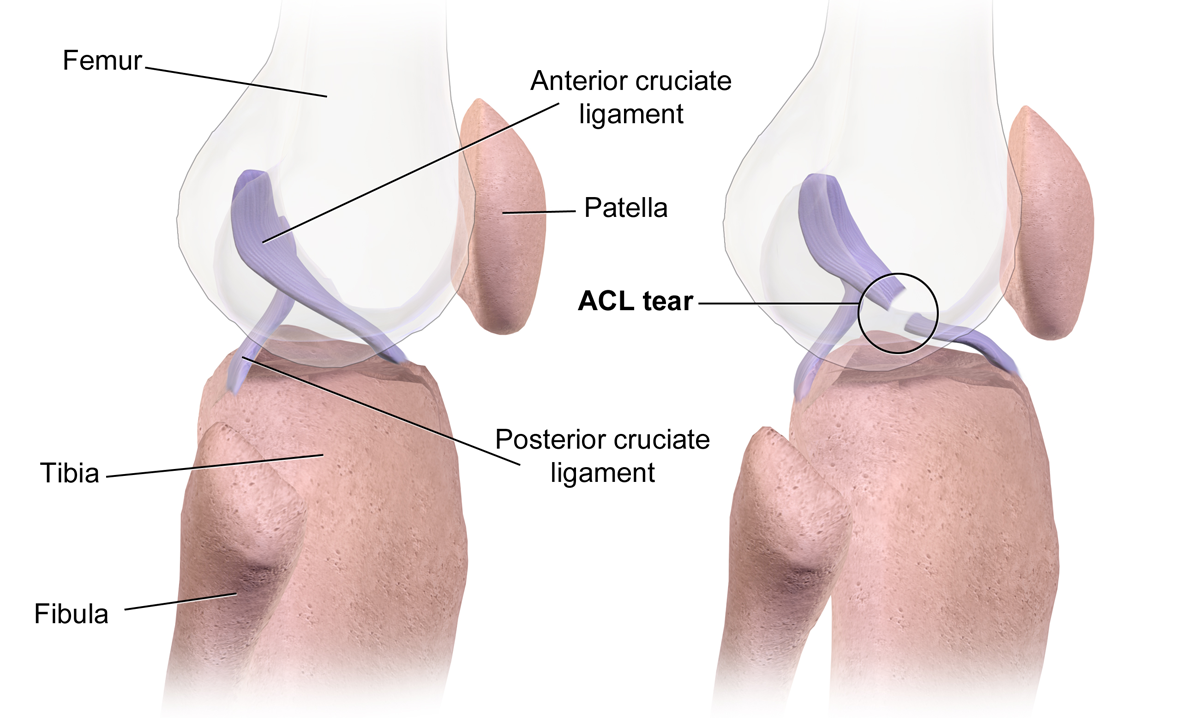
BruceBlaus, CC BY-SA 4.0, https://commons.wikimedia.org/wiki/File:ACL_Tear.png
Few diagnoses change a footballer’s season as dramatically as a ruptured anterior cruciate ligament. A player can be running at full speed one moment and facing months of rehabilitation the next, even when no opponent has made contact. The challenge is not merely restoring movement to the knee, but rebuilding the capacity to withstand the unpredictable demands of competitive football.
After reconstruction, a return to contact and pivoting sport commonly takes nine to twelve months, sometimes longer. That is a broad clinical expectation rather than a prediction for any individual player. The NHS recovery guidance notes that returning to sport can take up to a year.
What actually tears?
The ACL runs through the middle of the knee between the femur and tibia. Alongside the posterior cruciate ligament, it helps control the relationship between those bones. It particularly restrains excessive forward displacement of the tibia and contributes to rotational stability.
A sprain can involve limited damage to ligament fibres or progress to a partial or complete rupture. The word rupture is usually associated with a substantial disruption of the ligament. A knee may also have damage to its menisci, collateral ligaments or joint surfaces, and these additional injuries can alter treatment.
Footballers are vulnerable when they brake, plant a foot, change direction or land awkwardly. Contact can force the joint into an abnormal position, but many ACL injuries occur without a tackle. A player’s boot may remain planted while the body continues rotating, producing forces the ligament cannot accommodate.
Recognising an ACL injury
A sudden sensation of giving way, a pop, rapid swelling and difficulty continuing play are characteristic possibilities. Not every player experiences each symptom, and the initial intensity of pain is not a reliable indication of the structural damage.
A clinician will examine the knee, including tests of ligament stability such as the Lachman test. Magnetic resonance imaging can help identify the tear and associated soft-tissue damage, while radiographs may be used to investigate suspected fractures. An assessment is necessary even when the player can walk off the pitch.
A severely swollen, unstable or deformed knee requires prompt medical assessment. Foot numbness, a cold foot or impaired circulation after major knee trauma requires emergency evaluation.
Why reconstruction is often considered
An isolated tear does not mean every patient must undergo surgery. Some people regain satisfactory stability through structured rehabilitation alone. Elite football places unusually high demands on rotational control, however, and reconstruction is frequently considered when the knee remains unstable or the athlete intends to return to pivoting competition.
Reconstruction usually involves placing a tendon graft where the injured ligament was located. Grafts may be taken from the hamstring, patellar tendon or quadriceps tendon, depending on the individual and surgical plan. The graft must become incorporated and remodel over time; the operation is the beginning of rehabilitation, not the end.
Before surgery, teams may work on swelling, knee extension and muscle activation. A meniscal repair performed alongside reconstruction can change the permitted loading and movement in early recovery.
The long road back to the pitch
The Aspetar clinical practice guideline supports rehabilitation that progresses through clinical and functional criteria rather than relying on a calendar alone.
Early work addresses swelling, movement and the loss of quadriceps function. As the knee tolerates more activity, rehabilitation introduces progressively demanding strength and coordination work. Maintaining fitness without exceeding the permitted knee load is another consideration for professional athletes.
Running, landing, deceleration and changes of direction are introduced when appropriate. Later sessions expose the player to football-specific problems, including reacting to an opponent, controlling the ball under pressure and performing repeated high-intensity efforts.
Full team training is not synonymous with being ready for ninety minutes. A player may require a period of controlled exposure to contact, followed by gradually increasing competitive minutes. Medical staff also consider confidence, symptoms after exercise and the quality of movement under fatigue.
Testing can include strength comparisons, jumping assessments and sport-specific measures. No single test can guarantee that reinjury will not occur, and an apparently strong result on one measure cannot cancel out important deficits elsewhere.
What professional football has taught us
Virgil van Dijk sustained a serious knee ligament injury against Everton in October 2020. The Premier League’s report on his planned surgery documented the setback, and Liverpool later reported that the defender returned to play 51 club matches during the following season. His experience illustrates how a major injury can interrupt a campaign without necessarily ending a top-level career.
Another relevant case is Álex Pastor. Málaga confirmed that the defender had torn his ACL and medial meniscus and also damaged the medial collateral ligament. Such combinations help explain why comparisons based on the label ACL alone can be misleading.
Research from the UEFA Elite Club Injury Study followed 118 professional male footballers following ACL reconstruction. A second ACL injury occurred in 21 of them after their return to training, as reported in the British Journal of Sports Medicine. This is a cohort finding, not an individual probability applicable to every player.
Frequently asked questions
Can a footballer play with a torn ACL? Some people retain enough functional stability for certain activities, but competitive football exposes the knee to unpredictable rotation. A return decision must be made with specialist assessment rather than by attempting to play through instability.
Is a six-month return realistic? Individual professional players have returned earlier than nine months, but early return is not proof of safety. Clinical guidance commonly recommends a longer period for pivoting sport alongside objective readiness assessment.
Does an ACL injury cause arthritis? The original trauma and associated damage can increase the long-term risk of knee osteoarthritis. Reconstruction may improve stability, but does not eliminate that risk.
Illustration: BruceBlaus, Wikimedia Commons, CC BY-SA 4.0. Unmodified.
Educational information only. This guide has not been independently medically reviewed and does not replace individual assessment or a clinician-led rehabilitation plan. Sources checked November 2026.