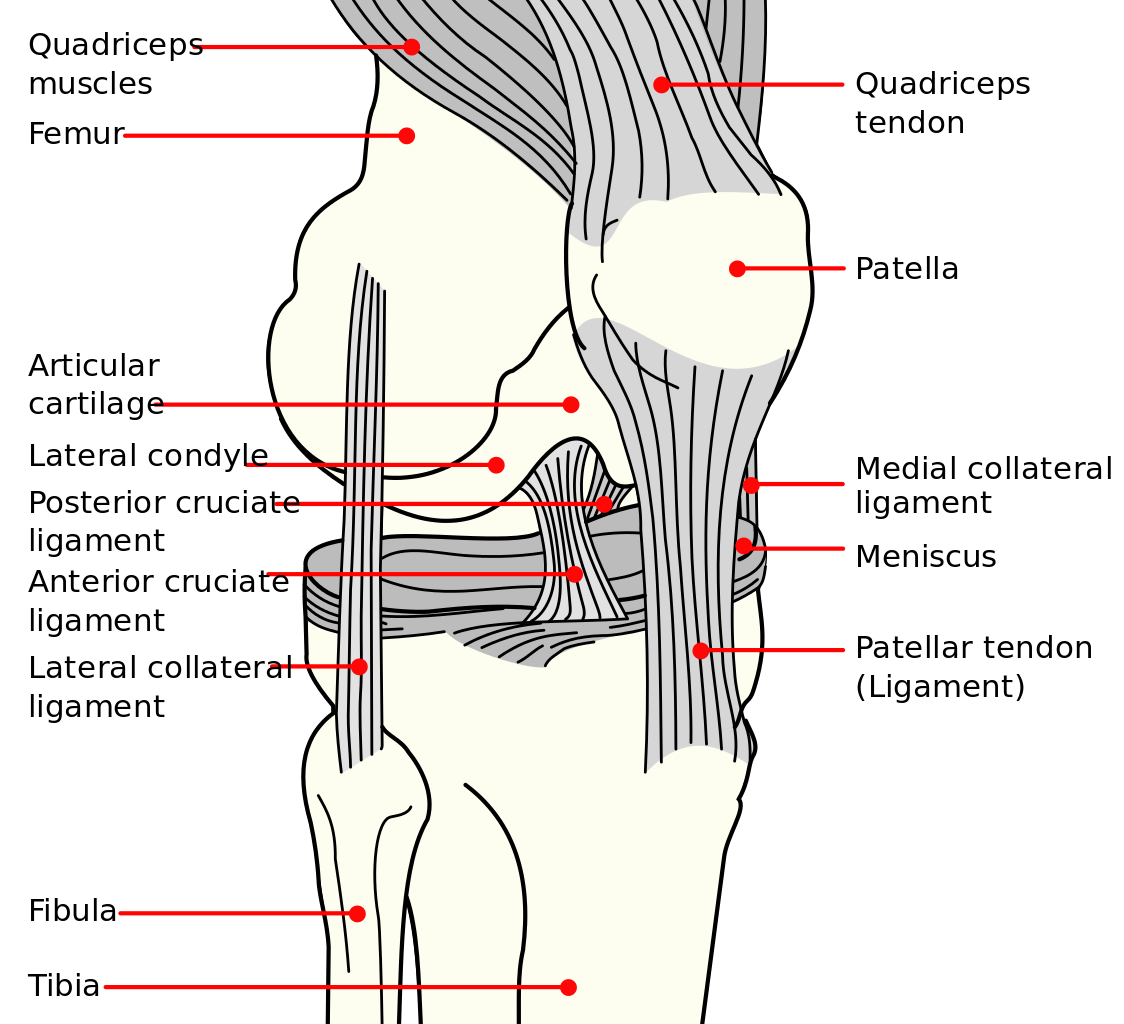
Public domain, Wikimedia Commons, public domain, https://commons.wikimedia.org/wiki/File:Knee_diagram.png
When a footballer’s knee is struck from the outside during a challenge, the ligament on the inner side can absorb much of the resulting force. This is the medial collateral ligament, commonly shortened to MCL, and an injury to it is a familiar cause of absence in professional football.
Unlike many complete ACL ruptures, isolated MCL injuries can often be managed without reconstructive surgery. That difference is important when a club announces ligament damage but does not immediately explain which ligament is affected.
A ligament on the inside of the joint
The MCL connects the femur and tibia along the medial side of the knee. Its superficial and deeper components help resist forces that push the knee inwards and contribute to rotational stability. It works in conjunction with other ligaments, muscles and joint structures.
A tackle against the outside of the leg can produce the inward movement known as valgus stress. Similar loading may occur when a player lands or changes direction without an opponent involved. The exact pattern depends on the position of the foot, knee and body at the time.
The UEFA study of 346 MCL injuries describes the significance of this ligament injury in professional football. It is particularly relevant because it examines actual time-loss injuries in players rather than assuming that all athletes recover in the same way.
The three broad grades
Grade one: limited ligament fibre damage with local tenderness and little or no clinically important instability. A player may recover sufficiently for sport within days or a few weeks.
Grade two: a partial tear with greater pain, swelling or laxity. Several weeks of rehabilitation may be necessary, depending on stability and the injury’s location.
Grade three: a complete tear with more substantial instability. Recovery may take many weeks or months, especially if other ligaments or the meniscus are involved. Some injuries require surgical treatment.
These descriptions are broad, not a schedule from which to calculate a guaranteed return date. The same grade can have different practical consequences depending on associated damage, the location of the tear and the physical requirements of the player.
How the medical team establishes the diagnosis
Tenderness on the inside of the knee, swelling and discomfort with side-to-side movement may indicate MCL damage. A clinician assesses whether the joint opens excessively under controlled stress and investigates other structures that may have been injured in the same incident.
MRI can establish the location and extent of damage and identify additional injuries. Radiographs may be appropriate if the mechanism suggests a fracture. A player who cannot bear weight, has a markedly unstable knee or experiences severe swelling should receive prompt assessment rather than rely on a presumed sprain.
The Royal Cornwall Hospitals NHS Trust guidance describes physiotherapy as part of managing these injuries, whether or not an operation is required.
Conservative treatment and the role of bracing
The MCL has a greater capacity for healing than some ligaments inside the joint. Many isolated tears are therefore treated with rehabilitation rather than surgery. Depending on the injury, the medical team may recommend temporary protection, modified weight-bearing or a hinged knee brace.
The purpose of a brace is to reduce unwanted stress while allowing an appropriate amount of movement. It is not necessary in every case, and the settings and duration depend on the injury. Unnecessarily prolonged immobilisation can contribute to stiffness and loss of muscle function.
Surgery may be considered for selected injuries where the ligament cannot heal satisfactorily in its original position, instability persists or the knee has suffered complex damage. Combined injuries need their own treatment plan.
What happens between walking and playing?
Early rehabilitation aims to reduce pain and swelling and recover comfortable knee movement. Strength work then addresses the muscles that support and control the joint, including the quadriceps and hamstrings. The medical team gradually increases load as the ligament and surrounding structures tolerate it.
Straight-line running may be considerably easier than cutting across an opponent or making a tackle. Later stages therefore include lateral movement, acceleration, deceleration and increasingly demanding football-specific work. The knee’s response during and after activity matters, as symptoms may not become evident until later.
A return to competition generally depends on adequate stability, useful range of movement, strength and functional performance. The player also needs confidence in the knee when reacting to unpredictable events. A positive training session is encouraging, but repeated tolerable exposure is more informative than a single milestone.
Why combined ligament injuries are different
In December 2022, Colchester United confirmed that Alan Judge had ruptured three knee ligaments, including the MCL, ACL and PCL. It was a very different diagnosis from a straightforward isolated medial ligament sprain.
Málaga also confirmed a grade two MCL injury alongside a PCL rupture in defender Moussa Diarra during his loan spell at Marbella in 2024/25. Diarra underwent surgery for the combined injury. Such cases explain why a serious knee injury cannot be assigned a typical isolated-MCL timetable without further information.
A player with an isolated injury and another with damage to several stabilising structures may both be described as having an MCL problem. Their treatment and rehabilitation can nevertheless differ substantially.
Questions about medial ligament damage
Does a grade three MCL tear always require surgery? No. The location, stability and other injuries influence that decision, and some complete isolated tears can be managed without an operation.
Can a player train while wearing a knee brace? A brace may form part of a clinician-directed rehabilitation plan, but wearing one does not establish readiness for contact football.
Is MCL damage the same as an ACL rupture? No. They affect different ligaments with different mechanical roles and healing characteristics. Combined damage is possible, which is why an accurate diagnosis matters.
Illustration: Public domain, Wikimedia Commons, Wikimedia Commons, public domain. Unmodified.
Educational information only. This guide has not been independently medically reviewed and does not replace individual assessment or a clinician-led rehabilitation plan. Sources checked November 2026.