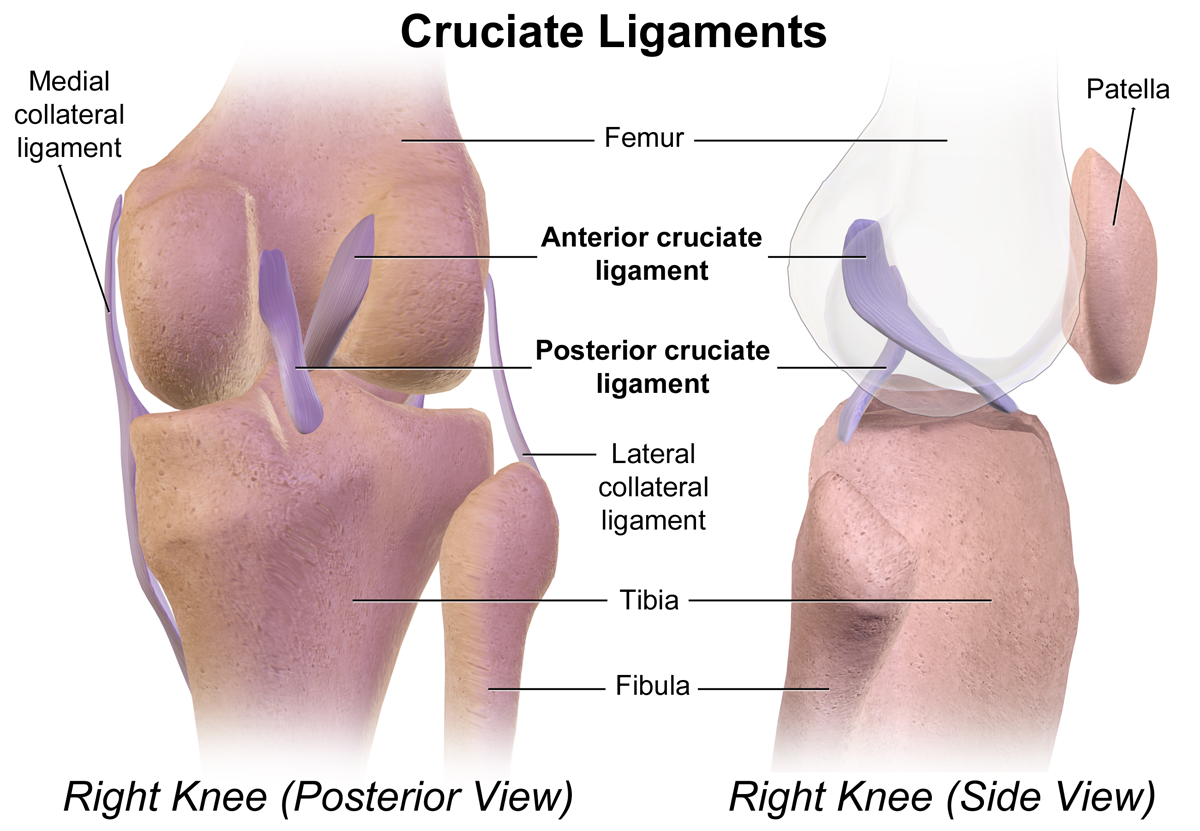
BruceBlaus, CC BY-SA 4.0, https://commons.wikimedia.org/wiki/File:Cruciate_Ligaments.png
The posterior cruciate ligament receives far less attention in football than its anterior counterpart. Yet damage to the PCL can cause substantial instability, disrupt a player’s season and, in complex cases, require a lengthy rehabilitation programme.
The distinction between the two cruciate ligaments is more than terminology. They resist different movements of the shin bone, and an injury to the PCL may be treated differently from an ACL rupture.
Inside the knee
The posterior cruciate ligament connects the femur and tibia within the joint. Its principal mechanical role is to restrict excessive backward movement of the tibia relative to the femur. It also contributes to rotational control and works alongside the other ligaments to maintain stability.
The ligament can be damaged when force is applied to the front of the shin while the knee is bent. A fall directly onto a bent knee, a collision or certain hyperflexion and hyperextension mechanisms can cause injury. In football, damage may occur alongside injuries to the collateral ligaments, joint cartilage or menisci.
The pattern is relevant because isolated PCL damage can sometimes be managed through structured rehabilitation, whereas a knee with several damaged stabilising structures may need a different surgical approach.
Why an injury may initially be missed
Pain, swelling, stiffness and a feeling of instability are possible symptoms. Some patients have less dramatic early symptoms than might be expected from a major ligament injury, and may be able to walk or even attempt to continue playing.
A specialist examines how far the tibia moves backwards relative to the femur and may use tests such as the posterior drawer test. MRI helps evaluate the ligament and associated injuries. Other imaging may be required when a fracture or complex injury is suspected.
The grade may be described in terms of partial or complete disruption, or by the amount of abnormal posterior movement demonstrated on examination. This means the reported grade should be interpreted in the context of the medical team’s findings, not simply compared with an ACL grading system.
Serious knee trauma with deformity, impaired circulation, numbness or a cold foot requires emergency evaluation because complex injuries can threaten structures beyond the ligaments.
Patrick Bamford and Martin Skrtel
Leeds United striker Patrick Bamford sustained a PCL injury during an under-23 match against Bristol City in September 2018. Reporting in The Independent documented the club’s initial expectation of approximately four months away.
Liverpool defender Martin Skrtel suffered posterior cruciate ligament damage against Manchester City in October 2008. The club’s confirmation, reported by ABC News and Sky Sports, distinguished the injury from an anterior cruciate ligament tear. Both cases illustrate the importance of identifying the specific ligament involved.
The most severe cases can involve several structures. Colchester United confirmed in December 2022 that Alan Judge had suffered a triple rupture involving the ACL, PCL and MCL. His injury should not be compared directly with an isolated PCL sprain.
How long is a player likely to be out?
A smaller isolated injury may be managed over a period of weeks, although returning to a demanding contact sport can take longer. More substantial tears commonly require months of rehabilitation. The condition of the other knee structures and the degree of persistent instability are crucial factors.
Following reconstruction, the Cambridge University Hospitals NHS rehabilitation guide identifies six months as an earliest possible return-to-sport point and discusses the benefits of meeting clinical criteria and allowing nine months after surgery.
The distinction between time since injury and time since surgery matters. An athlete who undergoes reconstruction after an unsuccessful period of conservative treatment may have a longer overall absence than a quoted postoperative timetable suggests.
Why rehabilitation may differ from an ACL programme
Some isolated PCL injuries are treated with bracing and structured rehabilitation. The aim is to restore useful knee function and stability while avoiding excessive backward movement of the tibia during the healing phase. Quadriceps function is particularly important in supporting the joint.
Early exercise selection needs to respect the PCL’s mechanical role. Certain hamstring-loading exercises can produce posterior tibial forces, so their timing may be modified according to the clinician’s protocol. This is one reason an athlete should not simply copy a rehabilitation programme designed for a different knee ligament.
Where surgery is indicated, the ligament may be reconstructed with a graft. The postoperative plan depends on the surgical technique and any additional procedures. A combined meniscal or collateral ligament injury may influence permitted motion and loading.
Later rehabilitation develops strength, balance, running tolerance and confidence. Football-specific work gradually incorporates stopping, turning and reactions to unpredictable movement. Clinical tests, symptoms and functional performance inform progression, with assessment continuing as the athlete returns to team training.
Medical clearance does not necessarily mean immediate restoration of preinjury performance. The player may still need competitive minutes and further conditioning to regain their usual level.
Common questions
Can a PCL rupture heal without surgery? Some isolated injuries can be managed successfully without reconstruction. Decisions depend on stability, associated damage, symptoms and activity requirements.
Is a PCL rupture worse than an ACL rupture? Neither diagnosis is universally worse. A severe combined PCL injury can be extremely disruptive, while an isolated PCL injury may have a more favourable course than a complete ACL rupture in a pivoting athlete.
Will the knee always feel normal again? Not necessarily. Residual laxity or discomfort can persist in some cases, and long-term joint health may be affected. Follow-up and continued rehabilitation may be important even after returning to football.
Illustration: BruceBlaus, Wikimedia Commons, CC BY-SA 4.0. Unmodified.
Educational information only. This guide has not been independently medically reviewed and does not replace individual assessment or a clinician-led rehabilitation plan. Sources checked November 2026.