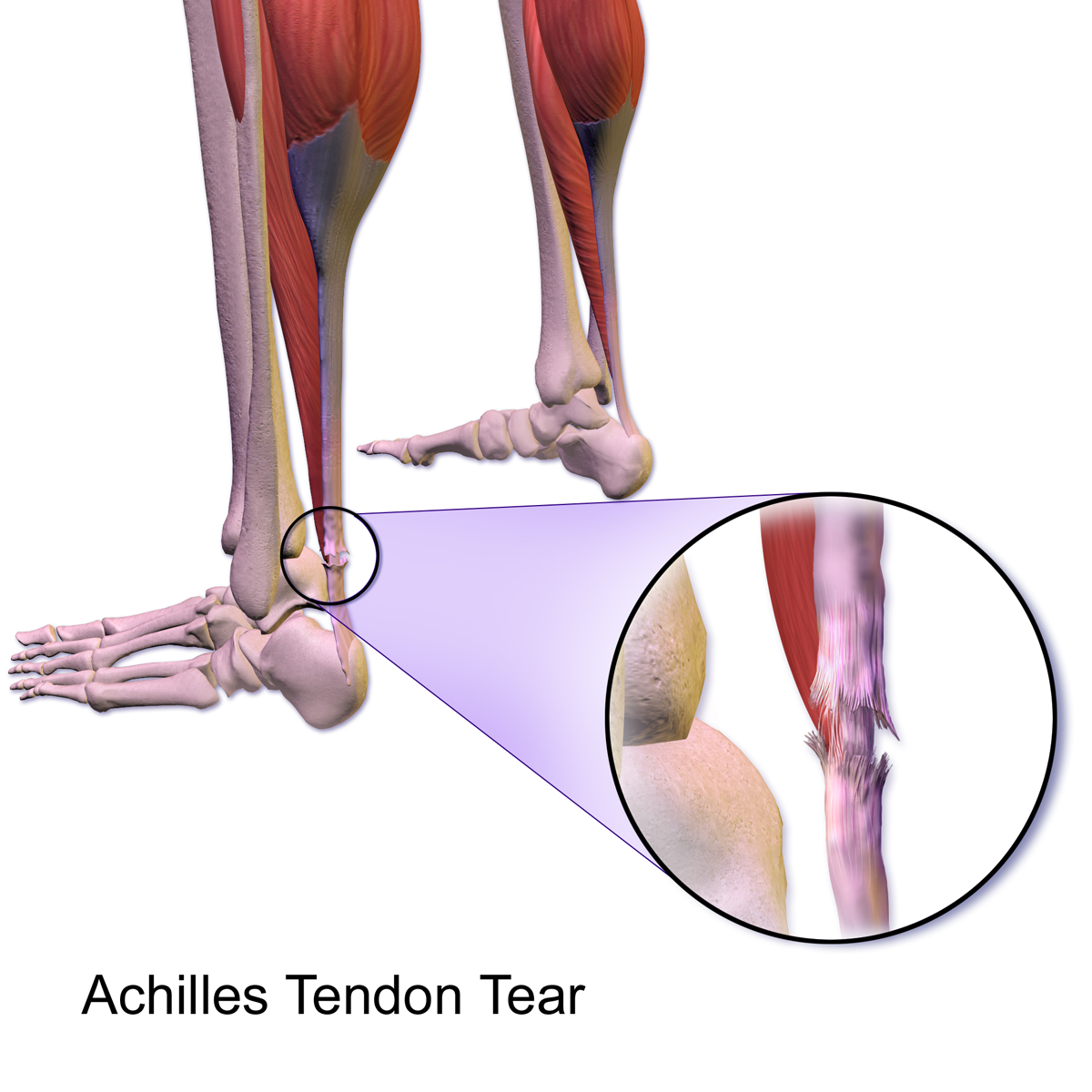
BruceBlaus, CC BY-SA 4.0, <a href="https://commons.wikimedia.org/wiki/File:Achilles_Tendon_Tear.png">Wikimedia Commons</a>, <a href="https://creativecommons.org/licenses/by-sa/4.0/">licence</a>. Unmodified.
An Achilles rupture can take away the explosive first step on which a footballer’s game depends. Even after the tendon has healed sufficiently for everyday movement, restoring the power required to sprint, jump and change direction may take many additional months. It is one of the clearest examples of the difference between returning to sport and returning to previous performance.
The tendon that drives the ankle
The Achilles tendon connects the gastrocnemius and soleus muscles of the calf to the calcaneus, or heel bone. It transmits muscular force to the foot and helps store and release energy during running and jumping. Football places considerable demands on this mechanism during acceleration and repeated changes of pace.
A rupture occurs when the tendon fibres are disrupted, sometimes completely. It can happen during a powerful push-off, a sudden lunge or an unexpected loading of the ankle. Previous tendon problems may be relevant, but a rupture can occur without a history of symptoms. It differs from Achilles tendinopathy, which involves tendon pain and impaired function without necessarily involving a complete tear.
Recognising the injury
Some people describe a sudden pop or the sensation of having been kicked behind the ankle, even when nobody has made contact. Weakness pushing off, difficulty rising onto the toes and pain or swelling may follow. The ability to walk does not exclude a rupture.
A clinician may assess the tendon and use a calf squeeze test, with ultrasound or MRI when additional information is required. Suspected rupture should be assessed promptly. Continuing to play or repeatedly testing the tendon with forceful heel raises is not an appropriate way to establish whether it is intact.
An operation is not inevitable
Both surgical repair and non-operative functional management are established approaches. The decision depends on the rupture, individual circumstances and specialist advice. Surgery can bring wound and nerve complications, while both approaches carry a risk of rerupture and residual weakness.
The Cambridge University Hospitals guidance describes a staged rehabilitation approach. Early treatment commonly protects the tendon with the ankle positioned to reduce tension, followed by gradual changes in protection and movement as healing progresses.
A professional footballer’s desire to return quickly does not establish that surgery is automatically the best option. The rehabilitation required after either treatment remains substantial, and the treatment decision should be individualised.
A recovery measured in months
An absence of six to twelve months or longer is plausible for a footballer with a complete rupture, with the time to previous performance sometimes extending beyond a year. The Frimley Health rehabilitation guidance emphasises the lengthy recovery process and the possibility that regaining preinjury performance can take more than twelve months.
During healing, tendon length and the restoration of calf function matter. Excessive lengthening can impair the ability to generate force at the ankle. Rehabilitation must balance the need to protect healing tissue with the benefits of appropriately progressive loading.
Walking, removing a protective boot and returning to jogging are meaningful steps, but none establishes readiness for professional football. The player’s capacity to repeatedly produce and absorb force through the ankle is central to the later stages.
Callum Hudson-Odoi’s experience
Chelsea confirmed that Callum Hudson-Odoi ruptured his Achilles towards the end of the 2018/19 season. He had been enjoying a breakthrough campaign, making the injury particularly disruptive to his development.
In a later Chelsea interview, Hudson-Odoi and Ruben Loftus-Cheek reflected on their experiences of Achilles injuries. Hudson-Odoi described the difficulty of regaining his former power and confidence after returning. Loftus-Cheek also suffered an Achilles injury in 2019, missing the Europa League final.
Their experiences demonstrate that a return date is only one measure of recovery. Players whose style depends on sudden acceleration may notice limitations that are less apparent during everyday activities.
The later stages of rehabilitation
Initial care focuses on protecting the tendon and following the prescribed weight-bearing and movement restrictions. As healing progresses, the medical team introduces appropriate strengthening and restores ankle function. Stretching or increasing load too aggressively during the early period can be counterproductive.
Later work develops calf strength and endurance, including the ability to generate force with both the knee bent and straight. Jumping and running are introduced when clinical findings and functional capacity permit. Progression is adapted to the individual rather than copied from a teammate’s rehabilitation timetable.
Football-specific work involves repeated sprinting, braking, jumping and reactions to unpredictable movement. Clinicians may consider heel-rise performance, strength, jumping ability and symptoms when assessing readiness. Competitive minutes can then be increased gradually according to the player’s response.
A player may still need additional conditioning after returning to matches. Maintaining calf capacity and monitoring workload remain relevant beyond the first appearance.
What supporters often want to know
Can an Achilles tendon heal without surgery? Yes. Non-operative treatment can be effective when appropriately selected and supervised, but it requires a structured programme.
Does the player always regain the same speed? Not necessarily. Strength, tendon mechanics, confidence and the effects of prolonged absence can influence performance. Recovery varies between individuals.
Is a rupture the same as Achilles tendinitis? No. Tendon pain and complete disruption are different diagnoses and require different clinical decisions. New sudden weakness after an injury should be assessed promptly.
Illustration: BruceBlaus, Wikimedia Commons, CC BY-SA 4.0. Unmodified.
Educational information only. This guide has not been independently medically reviewed and does not replace individual assessment or a clinician-led rehabilitation plan. Sources checked November 2026.